 ATCpal
What to Say During a TCAS RA: Phraseology Pilots Must Know
Learn what to say during a TCAS RA, including the exact readback, timing, and common mistakes pilots make when reporting a resolution advisory. · 4 min read
<link rel="stylesheet" href="/marketing-app/blocks.css?v=93fc9a8c">
<div class="mb mb-summary" style="--mb-accent:#5c6b7e;--mb-on-accent:#ffffff"><p class="mb-label">In short</p><p>When a TCAS Resolution Advisory (RA) triggers, fly the RA first, then tell ATC as soon as workload allows: your callsign, "TCAS RA," and whether you're climbing or descending. Don't ask permission to comply — the RA overrides any prior clearance — and don't key the mic again until you report "clear of conflict."</p></div>
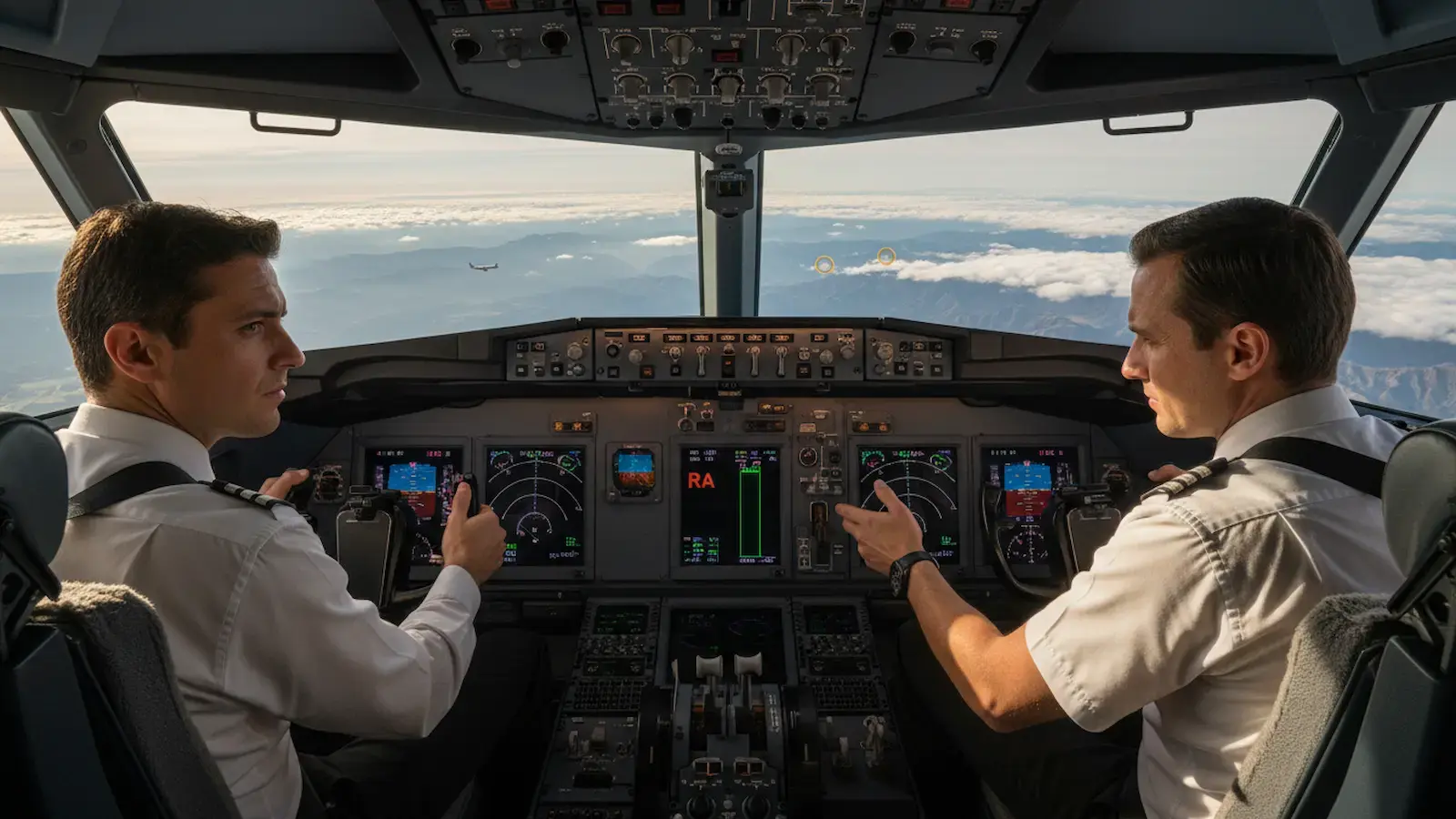
A TCAS Resolution Advisory can turn a calm cockpit into a high-stress moment in seconds. Knowing what to say during a TCAS RA before it happens is just as important as knowing how to fly the advisory itself, because the radio call that follows directly affects how the controller manages every other aircraft in the area. Get the phraseology wrong, or skip it, and the controller may keep issuing instructions that conflict with what your aircraft is already doing.
In this article
What a TCAS RA actually is
TCAS (Traffic Collision Avoidance System) issues two kinds of alerts: a Traffic Advisory (TA), which is informational only, and a Resolution Advisory (RA), which commands a specific vertical manoeuvre — climb, descend, or adjust vertical speed — to resolve a projected conflict. An RA must be flown immediately and takes priority over any ATC clearance in effect at that moment. Separation responsibility shifts to the pilot for the duration of the advisory.
Why the radio call matters
Once the RA fires, the controller has no way of knowing you're deviating from your assigned altitude unless you tell them. Other aircraft nearby may be getting instructions based on your last known clearance. That's why the report isn't optional small talk — it's how the controller re-establishes situational awareness around your flight path.
What to say during a TCAS RA
The standard call has two parts, spoken at two different times.
During the manoeuvre, as soon as workload permits: "[Callsign], TCAS RA."
If there's time to add detail, include the direction: "[Callsign], TCAS RA, climbing" or "[Callsign], TCAS RA, descending."
Once the conflict is resolved, report: "[Callsign], clear of conflict, returning to [assigned altitude]."
That second call tells the controller you're back under their instructions and clears the way for them to resume normal sequencing.
The required report
The key detail many pilots miss is timing. You fly the RA first — hands on the controls, eyes on the vertical speed indicator — and only transmit "as workload permits." Phraseology doesn't require an immediate call before you comply; it requires compliance first, then notification.
What not to say
Don't ask the controller "say again" mid-manoeuvre, don't request a new clearance, and don't argue about the advisory on frequency. The RA is not up for negotiation while it's active. If the controller's response afterward is unclear, it's fine to ask for a repeat rather than guessing — the Roger wilco say again guide covers how to request clarification without stalling the frequency.
Common TCAS RA phraseology examples
Climb RA example
Pilot: "Centre, Skyhawk 4521, TCAS RA, climbing." Controller: "Skyhawk 4521, roger." Pilot (after resolution): "Skyhawk 4521, clear of conflict, returning to six thousand."
Descend and maintain vertical speed RAs
Some RAs refine mid-event — for example, from "climb" to "adjust vertical speed" — but the radio call format stays the same. Report the manoeuvre type once workload allows, then report clear of conflict when TCAS removes the advisory.
Why pilots freeze during an RA
Mic fright is common during an RA, not because pilots don't know the phraseology, but because the aural alert, the flight director change, and the need to transmit all hit at once. Under that kind of pressure, it's easy to either over-transmit with unnecessary detail or forget to transmit at all.
Beating mic fright with practice
The fix isn't memorizing a script the night before a checkride — it's building the response until it's automatic. Practicing the call out loud, under simulated pressure, is what separates a clean readback under stress from a frozen microphone. ATCpal's talk-out-loud AI controller lets students rehearse radio calls — including unusual and high-workload scenarios — and grades each readback token-exact against FAA phraseology, so there's no guessing whether the call was right.
Try it before your next flight
<div class="mb mb-cta" style="--mb-accent:#5c6b7e;--mb-on-accent:#ffffff"><h3 id="ready-to-buy">Ready to buy?</h3><a class="mb-btn mb-btn-main" href="https://atcpal.app">Buy from ATCpal</a></div>
Phraseology sourced from the FAA Aeronautical Information Manual (Change 3, effective 9 July 2026) and the Pilot/Controller Glossary. Check the AIM · Last reviewed 13 August 2026.

